
From finger prick to results in 4 steps
Four steps, no appointment. You take a small blood sample at home, the lab measures IgE against 300 allergens and allergen components, and you get a detailed lab report that we explain in plain English.
The steps
Order the kit
One product, one price, no plan to pick. The kit arrives by post.
€300
Take a finger-prick sample
Wash your hands in warm water, prick the side of a fingertip with a lancet and let drops fall into the small tube until it reaches the line. Close the tube and pack it in the return packaging.
10 minutes
Post it to the lab
Use the return packaging in the kit. Post it early in the week so it doesn't sit in a sorting office over the weekend.
Return packaging included
Read your results
The lab measures IgE against each allergen on the panel. You get a detailed PDF lab report with every measured value and its class, from Negative to Very high, plus our English guide to reading it.
typically 5 days
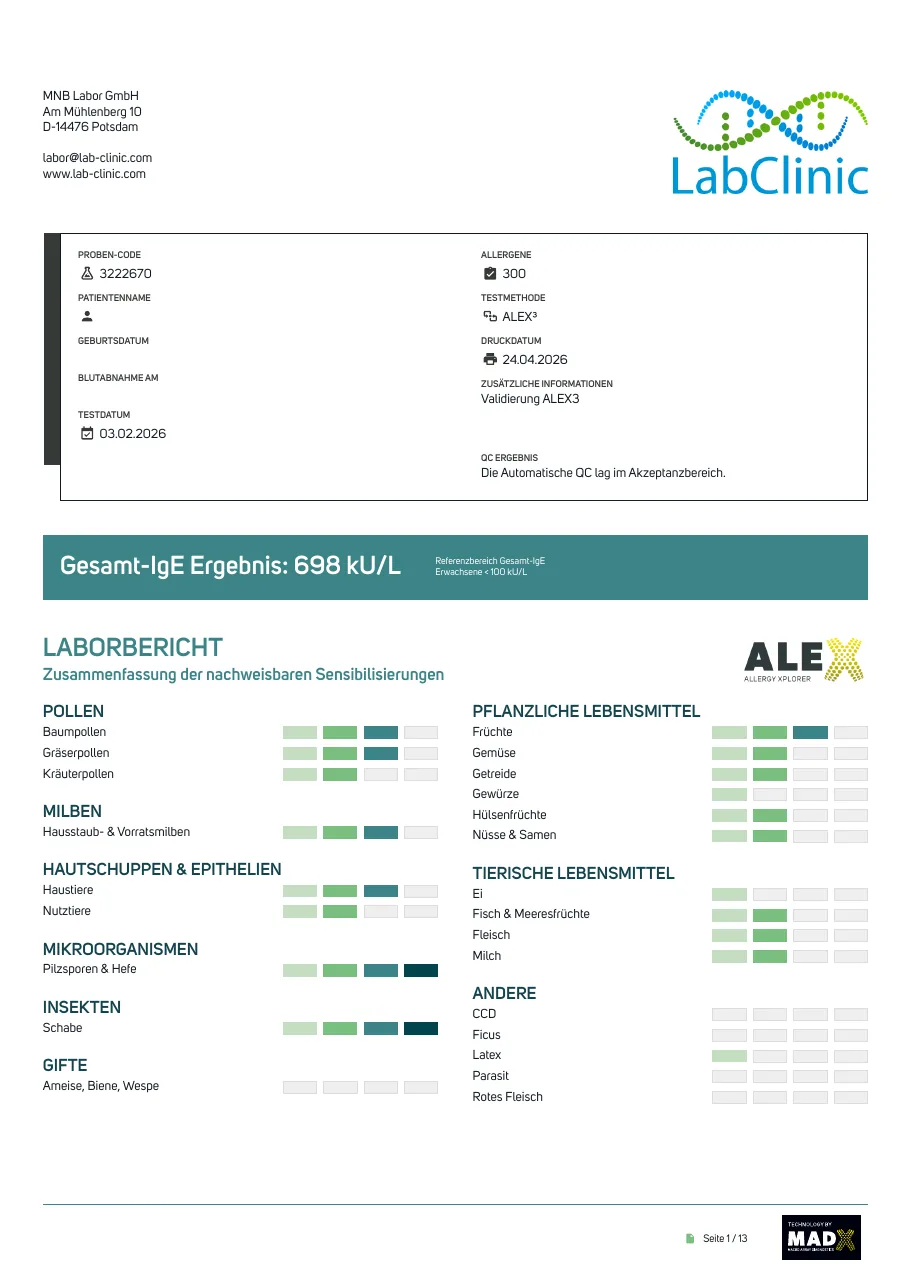 (Open full size)
See a real sample report
This is what you get: a detailed lab report from LabClinic, here generated from a real ALEX³ validation sample. Below we walk through each part in plain English, from total IgE to the last of the 300 values.
See a real ALEX³ resultWhat's in the kit
Everything you need for one sample. Our diagnostics partner Aniva Health packs the kit.
- BD single-use lancets for the finger prick
- BD serum collection tube for a small capillary blood sample
- Step-by-step guide
- Return packaging
What the lab measures
IgE is the antibody type your immune system makes when it has learned to recognise an allergen. LabClinic, a German laboratory (MNB Labor GmbH), measures how much IgE in your sample binds to each allergen on the panel, from birch pollen to shrimp.
The panel combines whole allergen extracts with single proteins, called molecular components. That matters: IgE to Bet v 1 in birch pollen together with IgE to Cor a 1 in hazelnut is a typical pollen-related cross-reaction pattern, which looks different from IgE to hazelnut's storage proteins, such as Cor a 9 and Cor a 14. A doctor reads that pattern with your history.
The lab also measures total IgE, the overall amount of IgE in your blood. It is not tied to one allergen; a doctor uses it as context for the specific results.
How to read the results
Each allergen and component gets a measured value in kUA/L, and the report puts each value in a class: Negative (below 0.3), Low (0.3 to 1), Moderate (1 to 5), High (5 to 15) or Very high (above 15). Page 1 sums it up by allergen group, so you can see the pattern quickly.
The classes describe the amount of IgE measured, not a medical instruction. Sensitisation is not the same as clinical allergy: plenty of people show IgE to grass pollen and never sneeze. Our sample report walks through every part of a real report. Take your own report to your doctor, especially for anything in the higher classes.
When to see a doctor first
If you have had swelling of the lips or throat, trouble breathing, a reaction to a sting, or a reaction that spread across your body, see a doctor before you do anything else. If it is happening now, call 112 in the EU or your local emergency number.
The test is for everyday symptoms with an unclear cause. It is not an emergency tool and it does not replace a doctor's assessment.
Questions
Does the finger prick hurt?
Briefly. The lancet clicks and is done in a moment. Warm hands make the blood flow more easily, so wash them in warm water first and let your arm hang down for a minute.
Do I need to stop antihistamines before the test?
Antihistamines do not affect an IgE blood test the way they affect a skin-prick test. If you take other medication, such as steroids or immune therapies, ask your doctor whether it matters for your result.
When should I post the sample?
Early in the week is best, so it reaches the lab before the weekend. Take the sample on the day you post it. The guide in the kit gives the exact posting days.
What if I don't get enough blood?
Warm your hands again and try the side of another fingertip with a fresh lancet. If the tube still doesn't reach the line, contact us before posting it and we will help.
300 allergens. One test.
A finger-prick sample at home, sent by post. A detailed lab report typically 5 days after the lab receives your sample, and our plain-English guide to reading it. €300, €1 per allergen.